Huggingface Overview
Hugging Face is a collaborative AI platform built for data scientists, machine learning engineers, AI researchers, and developers. Its main differentiator is a unified environment for hosting, sharing, and deploying machine learning models, datasets, and applications, all supported by a large open-source community and libraries such as Transformers and Diffusers.
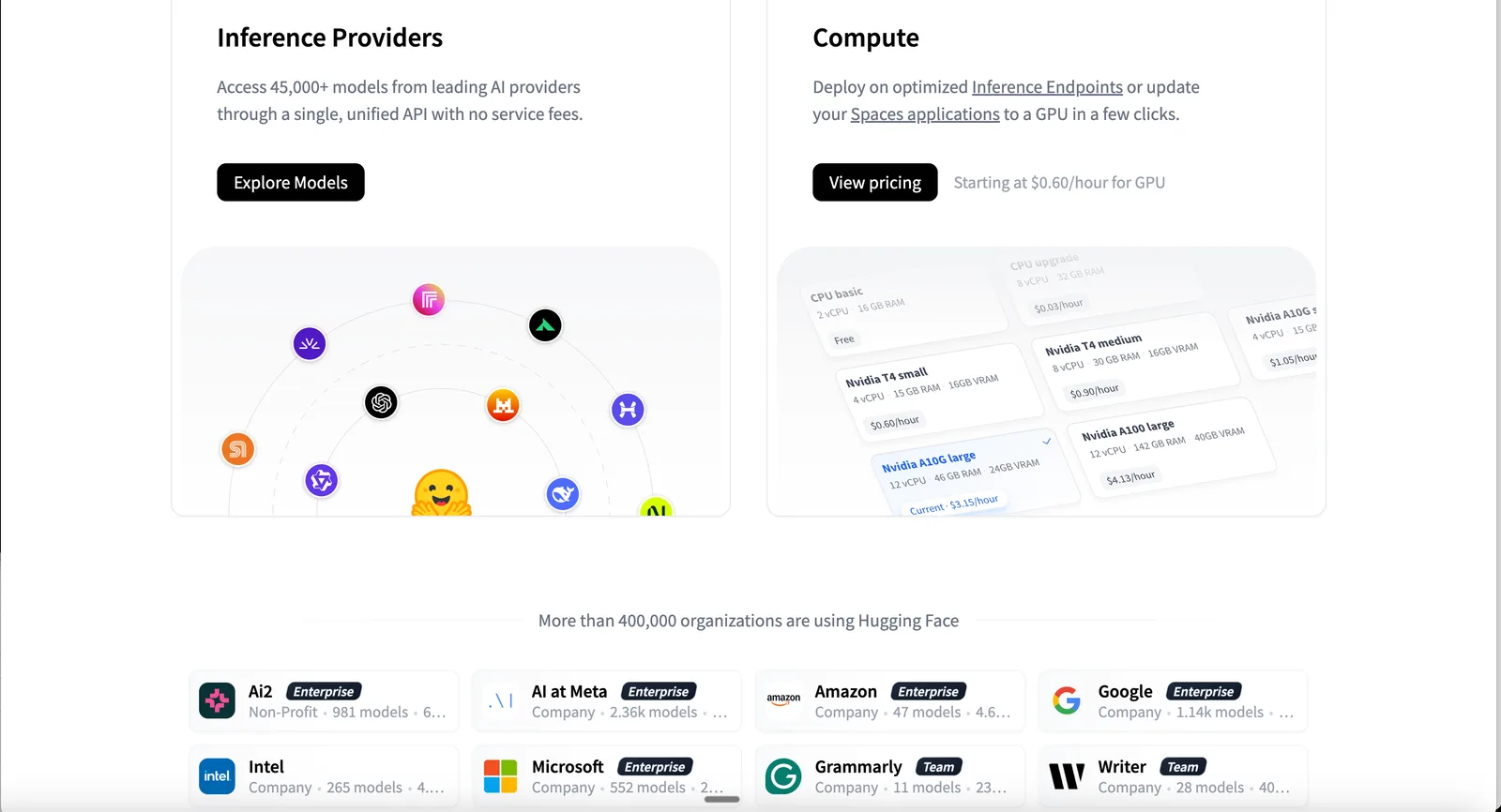
The platform features Model Hosting, which lets users host and collaborate on unlimited public models, datasets, and applications. Inference Endpoints allow deployment of models on dedicated, fully managed infrastructure, while the Compute feature provides on-demand access to GPU hardware starting at $0.60/hour. Inference Providers offer access to over 45,000 models from leading AI providers through a single API with no service fees.
Hugging Face’s core libraries include the Transformers Library for state-of-the-art PyTorch models, the Diffusers Library for advanced diffusion models, and the Datasets Library for sharing and accessing datasets for any ML task. The Tokenizers Library delivers fast, research- and production-optimized tokenization. Gradio enables building ML demos and web apps with minimal Python code, and Accelerate supports multi-GPU, TPU, and mixed-precision training for PyTorch models.
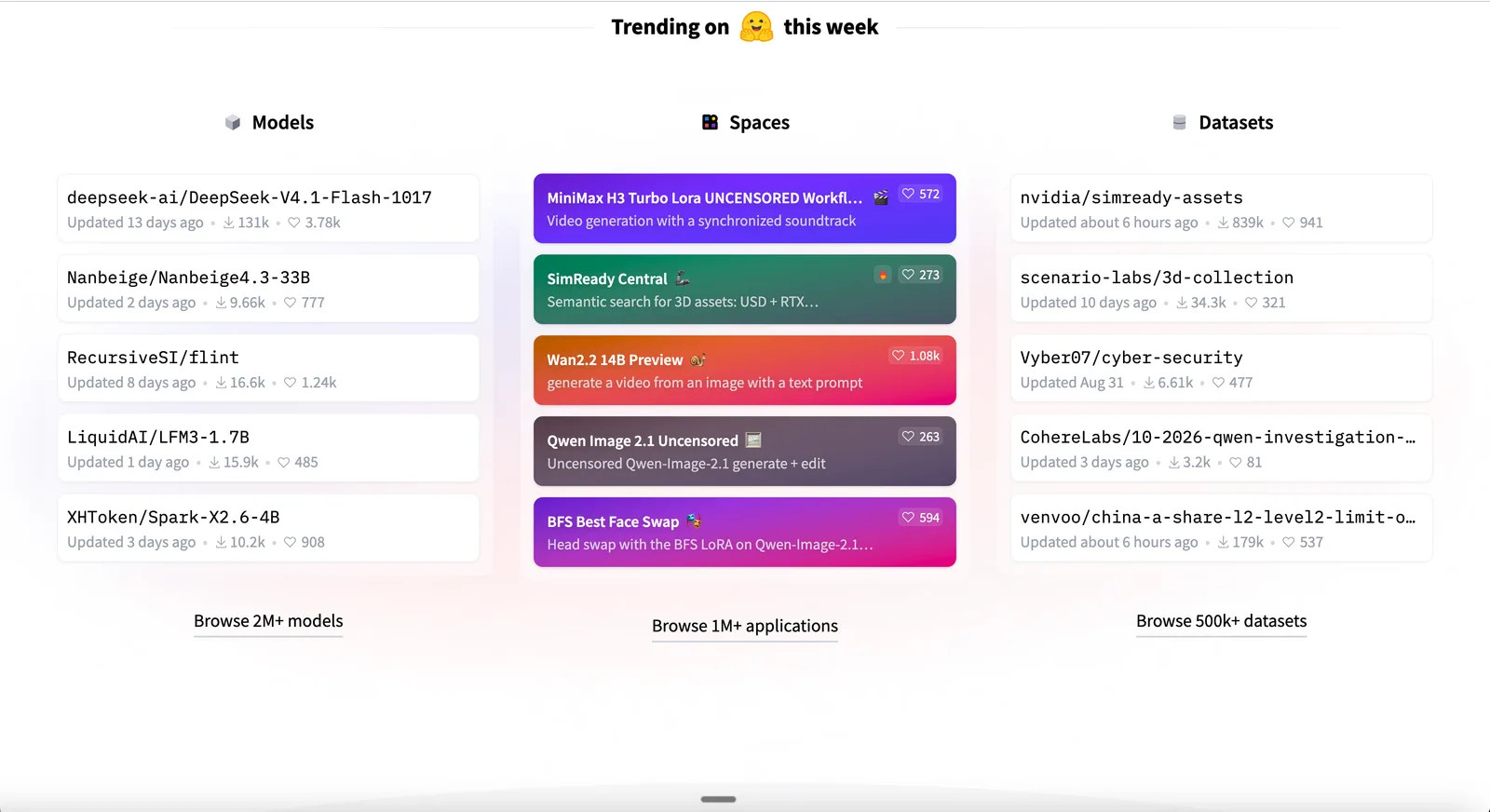
Recent updates as of October 2026 include the ability for organization admins to invite external collaborators directly from private repository settings, interactive 3D previews for OpenUSD and SimReady datasets, passkey support for sign-in and MFA, author-based filtering on models and datasets pages, and a faster tensor viewer for large sharded models.
Compared to alternatives, Hugging Face stands out for its extensive open-source libraries, unified hosting and deployment platform, and a large, active community. Some advanced features and compute resources require paid plans, but the platform’s breadth and collaborative tools make it a leading choice for AI development and research.
Features of Huggingface
Model Hosting: Host and collaborate on unlimited public models, datasets, and applications.
Inference Endpoints: Deploy models on dedicated and fully managed infrastructure.
Compute: On-demand GPU hardware starting at $0.60/hour.
Inference Providers: Access 45,000+ models from leading AI providers through a single, unified API with no service fees.
Transformers Library: State-of-the-art AI models for PyTorch.
Diffusers Library: State-of-the-art Diffusion models in PyTorch.
Gradio: Build ML demos and web apps with a few lines of Python.
Huggingface Use Cases
Collaborative Model Development: Teams of data scientists and ML engineers can host, version, and share models and datasets.
Production Model Deployment: Deploy models on managed infrastructure for scalable inference via Inference Endpoints.
Rapid Prototyping: Developers can build and share ML demos and applications using Gradio.
Dataset Sharing and Access: AI researchers can access and contribute to a vast library of datasets for various ML tasks.
Unified Model Access: Access thousands of models from multiple providers through a single API for experimentation and integration.
Pricing Details
Hugging Face offers three main pricing plans.
PRO Account: $9 per month — includes the ability to explore, experiment, collaborate, and build technology with Machine Learning.
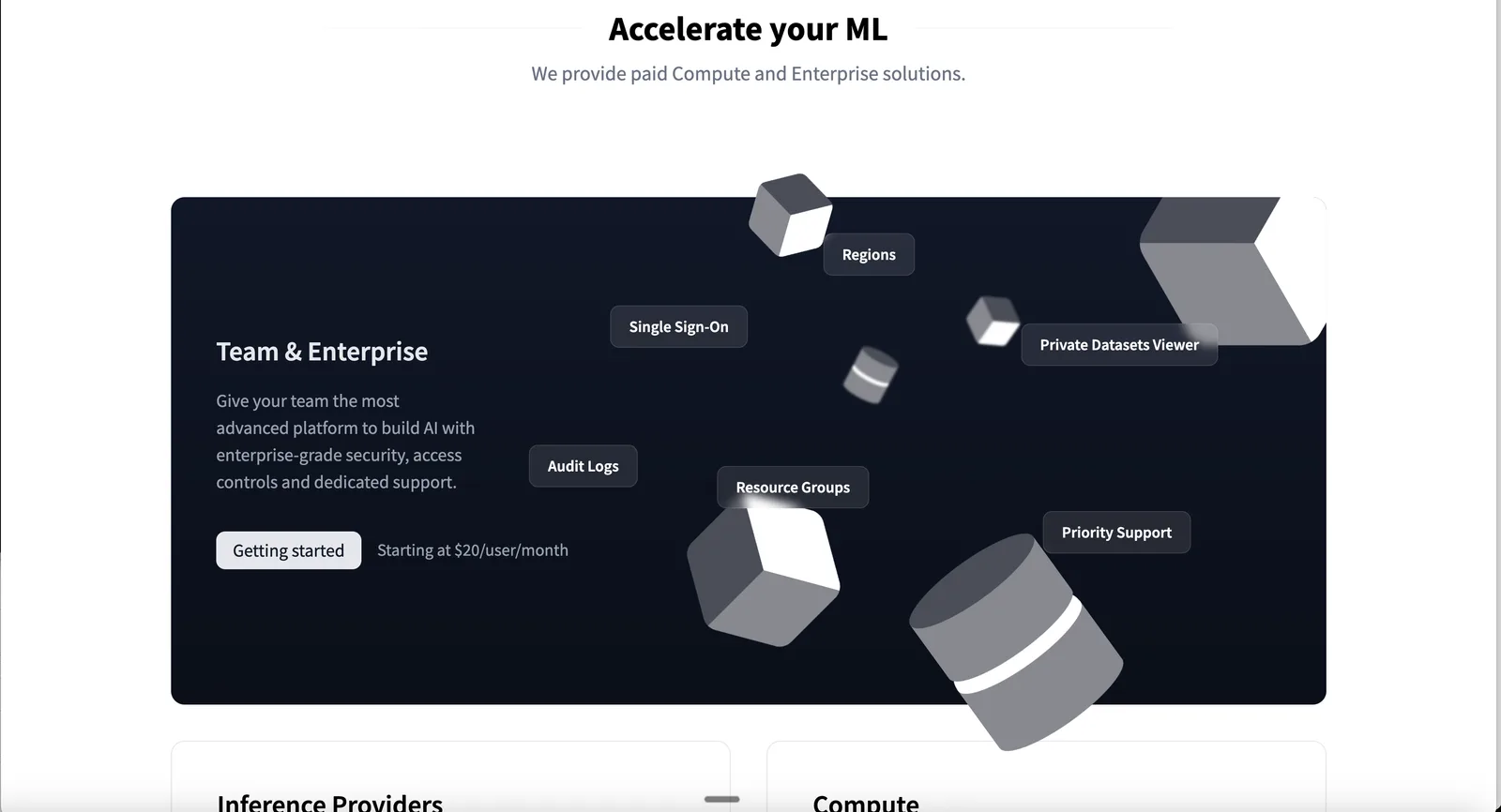
Team: $20 per user per month — includes Single Sign-On, Regions, Priority Support, Audit Logs, Resource Groups, and Private Datasets Viewer.
Enterprise: Contact for pricing — includes advanced platform features for building AI with enterprise-grade security, access controls, and dedicated support.
Huggingface Pros & Cons
Pros:
Model Hosting enables unlimited public collaboration on models and datasets.
Inference Providers offer unified, fee-free access to 45,000+ models.
Compute provides flexible, on-demand GPU resources.
Extensive open-source libraries (Transformers, Diffusers, Datasets, Tokenizers).
Cons:
Some advanced features require paid plans.
Compute resources may incur additional costs.
Product Images